
Choosing doll display stands
 AN IN-DEPTH DISCUSSION OF DOLL STANDS. Doll stands come in many designs and styles, and will function differently depending on specific design features. We’ve compiled a list of criteria to consider when deciding what stands will work best for specific doll display requirements. Our in-depth discussion is not to be taken as all-inclusive, but hopefully will provide enough information to give some ideas on how to choose the right stand for a particular doll display situation.
BASIC STAND TYPES. It is important first to have a good idea of what stands are available, and to understand enough about how they function in order to make informed choices about the stands you think you’ll need or want to use to display dolls in your collection. Basic types of doll stands currently available include the following:
AN IN-DEPTH DISCUSSION OF DOLL STANDS. Doll stands come in many designs and styles, and will function differently depending on specific design features. We’ve compiled a list of criteria to consider when deciding what stands will work best for specific doll display requirements. Our in-depth discussion is not to be taken as all-inclusive, but hopefully will provide enough information to give some ideas on how to choose the right stand for a particular doll display situation.
BASIC STAND TYPES. It is important first to have a good idea of what stands are available, and to understand enough about how they function in order to make informed choices about the stands you think you’ll need or want to use to display dolls in your collection. Basic types of doll stands currently available include the following:
- Magnetic Plate. Usually this type of stand is a flat round metal disk designed to connect with and secure a doll with tiny strong magnets embedded inside the bottom of the doll’s feet. This is an exclusive, limited type of doll stand rarely used with typical fashion dolls, and is mainly available with action figures or action fashion dolls like some Obitsu models. When deciding whether the flat metal plate is the best display option for a doll with magnetic feet, it’s important to determine if the doll is sturdy enough to remain upright in a chosen pose without any vertical support, as the foot plate will be the only item keeping the doll stationary in a display position. If the doll is wearing shoes with thick soles that might interfere with magnetic contact, or has loose joints or is wobbly and cannot remain upright without additional support, this type of display stand will not serve as a good display option.
- Insertion Peg Base. This type of stand consists of a foot base with short sturdy pegs that protrude upward for insertion inside holes in the doll’s feet. This is a vintage-style stand that was included with some early-issue dolls like some vintage Mattel Barbie dolls that had very little articulation and were manufactured with the intent for the doll to be left on display and not necessarily played with – although the doll could be removed from the stand for redressing and other play activities. The foot holes and pegs were very small in diameter, and shoes for the doll, if removable, also had to have coordinating holes in the soles to allow the display stand pegs to be inserted through the shoes. While this type of stand may be used occasionally with action figures, it is not readily available for or suitable for the display of modern fashion dolls that don’t have holes in their heels. However this type of stand is worth mentioning for the collector who may be on the lookout for vintage dolls and display equipment.
- Leg Grip Base. Stand bases designed with lower leg grips are generally compact and made mainly for action figures, although they might be adapted for use with certain fashion dolls. Typically this type of stand is solid-molded plastic, with slightly flexible leg grips to avoid breakage when the grips are slid around the legs of the doll. Note that if the doll is wearing thick pants or boots, the extra thickness could impact the ability to slide the grips over the doll’s legs. It’s also important to consider whether or not the doll is sturdy enough to maintain an upright position without additional vertical support. Aesthetically, leg-grip stands may prove to be visually obtrusive, depending on the type of clothing the doll on display is wearing, and the overall size and visual impact of the leg grips.
- Waist Grip Stand. Typical economy waist grip stands consist of a base to support the doll’s feet, to which a back vertical support bar is attached, with a semi-flexible C-shape grip at the top designed to clamp around the back and sides of the doll’s waist. Most modern waist grip stands are height-adjustable to accommodate a variety of dolls. The quality, functionality, and overall design can vary greatly between stands produced by various manufacturers. For example, Mattel often includes waist grip stands with dolls above economy play-grade. These have a standard plastic base with a sturdy back rod molded with vertical grooves or protrusions to hold the waist grip steady as it slides up and down for adjustment. The grip on this type of stand is prone to breakage because the relatively thin grips are not adjustable and not particularly flexible. Most dolls wearing clothing have too much thickness for the grip, so the grip must either be inserted through a back opening in the clothing to grip the doll’s bare waist, or the grip must be inserted between separate clothing pieces to grip the doll’s bare waist. In either case, the aesthetics of the waist grip stands leave much to be desired, because the clothing often looks pinched or bunched up where the grip fastens to the doll.
- Flex Wire Grip Stand. Flex wire grip stands usually are designed to grip the doll at the waist, but they are made different from the back-support-type sliding waist grip stand described above. A flat support base with an attached hollow vertical support post allows a tightly bent sturdy flexible wire to be inserted down inside the back support post. The protruding top ends of the bent grip wire are shaped to encircle or slide around the doll’s waist. Because the wire grip slides inside a support post at the back of the doll, the stand usually offers height adjustment. Also because the waist grip wire is flexible metal, it is not very prone to breakage and can be spread apart at the top to accommodate a variety of doll widths. The quality and design sophistication of this type of stand can vary greatly and range from stands with crude wooden bases to elegantly designed all-metal stands.
- Kaiser Brand Wire Grip Stand. By far the most desired brand manufacturer of the wire waist grip type of doll stand is KAISER. Kaiser stand design is precise and functions extremely well for most fashion doll display needs. The wire waist grip is generally very small so it can be slid up underneath clothing either from the back or through a back opening. When gripped around the doll’s waist outside the clothing, the small grip wire is flexible enough to minimally impact the lay and flow of doll garments, and is generally not very visible. Because this specific doll stand brand has a precise adjustable fit and is visually unobtrusive in most display situations, it is a clear favorite choice among doll collectors.
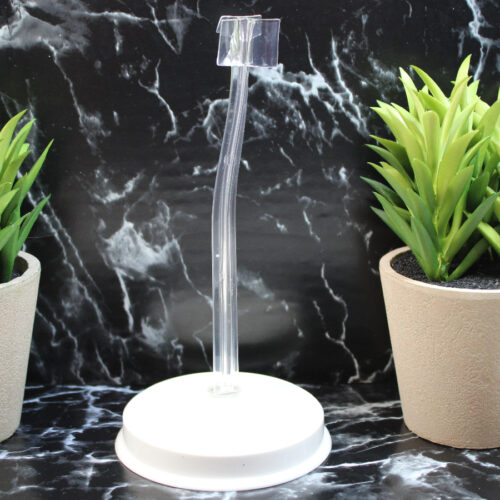
- Saddle or Cradle Stand. As the name implies, this type of stand supports the doll at the crotch area, between the legs, in an upright position, so the doll must be able to maintain an upright posed position with only this area of the doll being supported. The support piece can come in many different styles, shapes, and designs. On adjustable high-end doll stands, the cradle piece is very flat and small, to be as visually unobtrusive as possible while still providing support. High-end fashion dolls usually come with saddle/cradle stands, with the cradle piece attached to a metal telescoping rod to provide a range of height adjustments. Economy cradle stands often consist of a hard plastic base with a snap-in vertical support, with the cradle piece molded on top. Molded non-adjustable crotch stands are generally made of a specific type of doll and are not usually adaptable to different types of dolls. The molded-in cradle piece may consist of preset thigh grips rather than a crotch support, making it even more specific to a particular doll type.
- Chest / Underarm Cradle Stand. A stand that supports a doll around the back and under the arms usually consists of a base with a back support rod topped with a wire bent in a horizontal square U-shape to slide behind the doll under the arms where the shoulders meet the torso. Some designs incorporate an adjustable telescoping support rod that allows changes in height to accommodate a variety of different dolls. A potential drawback to this style of stand is the top support cradle – it usually is not flexible or adjustable in width and therefore can only support a doll with a specific chest size. A small support cradle may be able to support a doll with a larger chest, but the support contact point will be lower on the doll where the torso narrows toward the waist. For a doll with a chest area smaller than the capacity of the wire cradle, support may not be stable, causing the doll to sway or tilt. Or, the cradle may be too wide to fit under the doll’s arms at all. Visually, if the stand fits the doll well, the support cradle usually will not appear too obtrusive, because only the wire cradle tips will show under the doll’s arms.
- Hybrid or Specialty Stand Styles. Some collector dolls may come with doll stands designed specifically to support and display that particular doll, and may not be adaptable for general display of a variety of other dolls. Examples of this include articulating waist-grip or crotch-grip stands designed to display dolls in motion poses – like ballerina dolls or mermaid dolls. Some hybrid stands may include molded background or surrounding design elements intended for a specific themed doll, such as molded water features or shell backdrops for mermaid-themed dolls, or molded rocks and other features intended to suggest an alien planet for space-themed dolls. Because these stands typically incorporate unique additional features, they are not readily adaptable for general generic display, and may take up valuable extra space that could otherwise accommodate multiple additional dolls on display stands with a smaller overall footprint.
- Support Height. The number-one consideration when deciding if a stand will work with a doll is the height of support. Ideally, a dressed doll should be displayed so that the doll’s shoe bottoms touch the support surface securely enough to prevent wobble or slippage, but without allowing too much weight or pressure to bear down on the doll and cause the legs to bend unexpectedly or the shoes to deform. A doll stand with adjustable height is preferable to one that lacks that capability. An adjustable stand can be changed to accommodate a larger variety of dolls of different heights, or dolls with different shoe heights that would slightly impact the support height needed, depending on fashion changes. It is preferable to have a doll displayed at a height where the feet rest securely on the base to prevent tilting, without smashing down the doll’s shoes to the point that the heels or other features are deformed. It is generally not advisable to display a doll with space between the base and the bottom of the doll’s feet, because this can create display instability where the doll can easily fall off the display stand.
- Support Width. Almost equally important to height consideration is the need for the stand to correctly accommodate the doll’s girth at the support point. For cradle/saddle stands, girth is not usually a critically determining factor unless the cradle piece is too large to fit between the doll’s legs or does not line up properly to provide adequate support. As discussed above, waist grip stands need to have flexibility in the grip to adequately accommodate a variety of dolls of different sizes or that will wear varying layers of clothing, The same consideration applies to arm/chest cradle stands, again as previously discussed above. A flexible waist grip with built-in adjustability is the ideal stand for most doll display situations.
- Most cheap economical stands will not be able to offer optimal functionality for the price, due to cumulative manufacturing costs. Generally, the more complicated the design, or the higher the quality of materials, the more the stand will cost to produce, resulting in a higher purchase cost. Every collector must decide whether in the long run it is more desirable to buy cheap and later face potential dissatisfaction with the stand’s functionality or durability, as opposed to investing more funds up front to procure stands that are likely to provide satisfactory service over the long-term.
- Many collectors end up trying a variety of stands before settling on the type they prefer. After experience field-testing various stand types, some collectors will opt to, over time, replace less desired stands with preferred designs. Some collectors who have a variety of different dolls on display may find that different types of stands suit different dolls better. Sometimes the cheap economy stands work just fine for play-line dolls, while more expensive better-designed stands can be reserved for higher-end dolls. Ultimately it is up to each collector to decide what works best for their particular situation.
- Our overall top choice in doll stand, based on our own experiences with various types and brands of display stands, is the Kaiser enamel-coated metal waist grip stand. Kaiser stands come in a few colors and some different standard sizes to accommodate different makes and scales of dolls. The size we prefer for one-sixth-scale fashion dolls is the small waist grip for typical 11.5 inch dolls. For male dolls, there is a slightly larger waist grip available that works very well. With a smooth precision fit and adjustable design, this Kaiser stand is also one of the most expensive stands available. However, careful price-shopping and buying in bulk (12-pack sets) can help keep costs down.
- Avoid knock-off imitators! One important thing to keep in mind is that there are knock-off metal stands out there that, at first glance, look very similar to Kaiser stands. However, upon close inspection, one can pinpoint the critical differences between the knock-offs and the genuine item. The critical key difference is in the exact size and bend of the waist grip wire. The Kaiser brand is usually smaller and more refined, while imitation stands will have a slightly larger waist grip with a less refined grip angle. While we have never personally used a knock-off brand imitation of the Kaiser stand, it is apparent that the knock-off waist grip will function less elegantly with a less precise grip.
